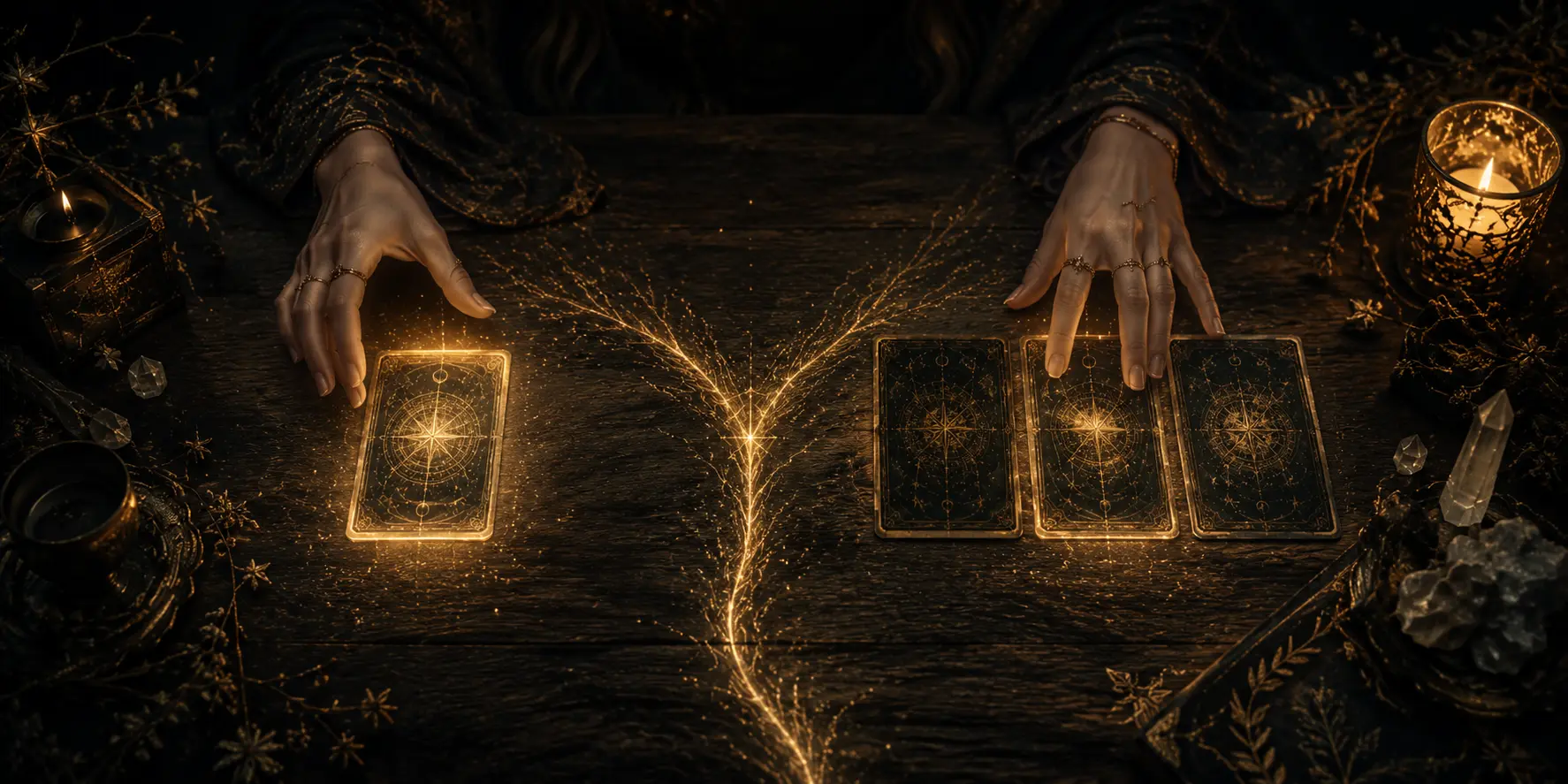
You do not need a huge spread covering half the table every time you want to consult the cards.
For many questions, one card is enough.
At other times, a single card may only show one part of the situation, while three cards help you understand how several parts relate to each other.
The important question is not how many cards you can draw. It is how many you actually need.
When one card is enough
A one-card reading works especially well for clear questions such as:
What am I overlooking?
What should I focus on today?
What matters most in this situation?
What could influence my decision?
What should I pay attention to?
Its biggest advantage is simplicity.
There is only one card and one main idea to consider. You do not have to work out how several different symbols relate to one another.
That also makes one-card readings a good place to start if you are new to cards.
One card does not mean one-word answers
A single card can still contain a great deal of meaning.
It may offer a central message, a warning, practical advice or a question for reflection.
The reading is simple because there is only one card — not because the interpretation has to be shallow.
When three cards work better
Three cards become useful when a situation has several parts.
For example:
The situation – What influences it – What you can do
or:
Past – Present – What develops next
Different decks can also use their own positions.
A three-card elemental reading, for example, could ask:
What is dominant – What is missing – How to restore balance
The important part is that each position has a purpose.
You are not simply drawing three random pictures. Each card answers a different part of the same question.
More cards do not always mean more clarity
It is easy to keep drawing when you are uncertain.
One card gives an answer. A second adds something. A third changes the picture. By the fifth, you may be more confused than when you started.
More information is not always better information.
If your question is simple, begin with one card. Move to three when you genuinely need to separate the situation into several parts.
What about a Daily Card?
A Daily Card is a special kind of one-card reading.
You do not necessarily need a specific question. The card simply gives you a theme to notice during the day.
That is also why repeatedly drawing a new Daily Card makes little sense. It is often more interesting to stay with one card and see whether its meaning becomes relevant as the day unfolds.
So which should you choose?
Choose one card when you want one clear perspective.
Choose three cards when you want to understand how several parts of a situation interact.
And if you are unsure, start with one.
Sometimes one good question and one carefully considered card can be more useful than ten cards spread across the table.